
Science · 1 view
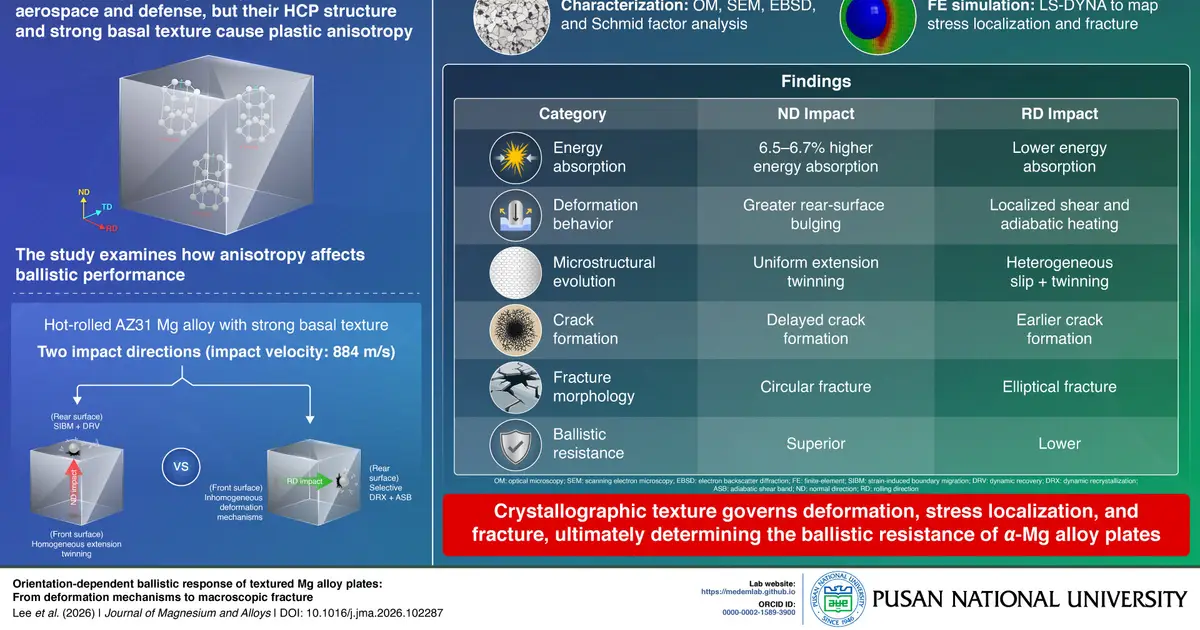
Crystal alignment explains why magnesium alloy plates resist ballistic impacts better in one direction
Magnesium (Mg) alloys offer a pathway to lighter, more efficient aerospace and defense structures because of their low density, high specific strength and excellent damping capacity.

AI Summary
Magnesium alloys are attractive for aerospace and defense because they are lightweight, have high specific strength, and damp vibrations well. Their crystal structure is hexagonal close‑packed (HCP). In an HCP lattice, how the material deforms depends strongly on the orientation of the crystal grains. This orientation dependence can affect how the alloy behaves under impact or load. The study investigates how aligning the crystals can improve ballistic resistance in a preferred direction.
AI summaries can be wrong sometimes—always verify important details using the source article.
How AI & Automation are usedMore from Science
Continue reading recent Science coverage
- Hydrothermal vents supply a geochemical precursor of ATP that could have powered early lifeContinue reading
- AI techniques behind image creation improve flash flood forecasts across U.S. river basinsContinue reading
- X-ray technique reveals how quantum materials respond to laser pulses in real timeContinue reading
- Hydra loses its immortality after cold triggers switch to sexual reproductionContinue reading
Support HappeningNow
Independent AI-powered news analysis is reader-supported. Your contribution helps cover infrastructure, summaries, and continued platform development.
Support HappeningNow