
Science · 52 views
Physicists crack the math connecting ultraslow quantum magnetism to ultrafast black-hole physics
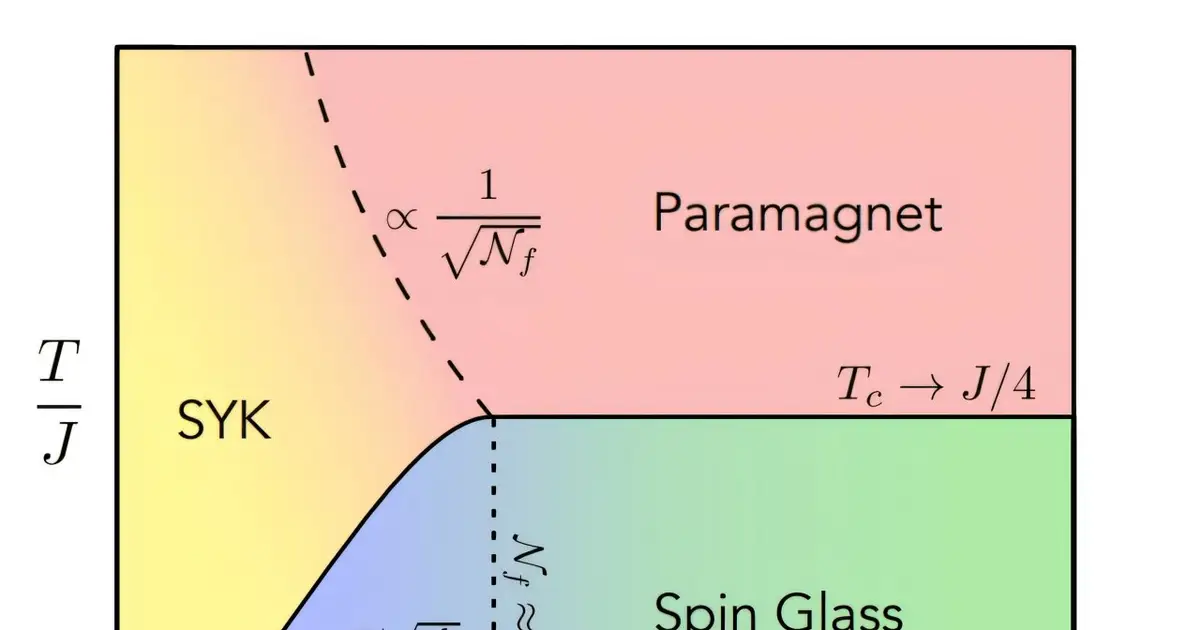
A team led by University at Buffalo physicists has found a mathematical solution that shows how a frustrated quantum magnet can transition from ultraslow behavior to ultrafast, highly entangled behavior resembling that of a black hole.

AI Summary
A team led by University at Buffalo physicists has derived a mathematical solution that links a frustrated quantum magnet’s ultraslow dynamics to an ultrafast, highly entangled regime. The study shows that spin glasses—materials where atomic magnets point in random, frozen directions—can evolve into states described by the Sachdev‑Ye‑Kitaev (SYK) model. The SYK model, used to explore black‑hole physics, quantum chaos, and other exotic phenomena, provides a framework for understanding the rapid entanglement observed in the magnet. The solution bridges the gap between disordered magnetic systems and the fast, entangled states that mimic black‑hole behavior.
AI summaries can be wrong sometimes—always verify important details using the source article.
How AI & Automation are usedMore from Science
Continue reading recent Science coverage
- Injectable nanoparticles make blind retinas respond to light in preclinical studyContinue reading
- AI companions may erode social skills among isolated users, framework suggestsContinue reading
- RHIC data reveal intriguing dip in momentum fluctuations in high-density nuclear matterContinue reading
- Light beam 'swims' upstream through a quantum fluid by violating Newton's third lawContinue reading
Support HappeningNow
Independent AI-powered news analysis is reader-supported. Your contribution helps cover infrastructure, summaries, and continued platform development.
Support HappeningNow