
Science · 4 views
Macromolecular crowding could help build artificial cell systems
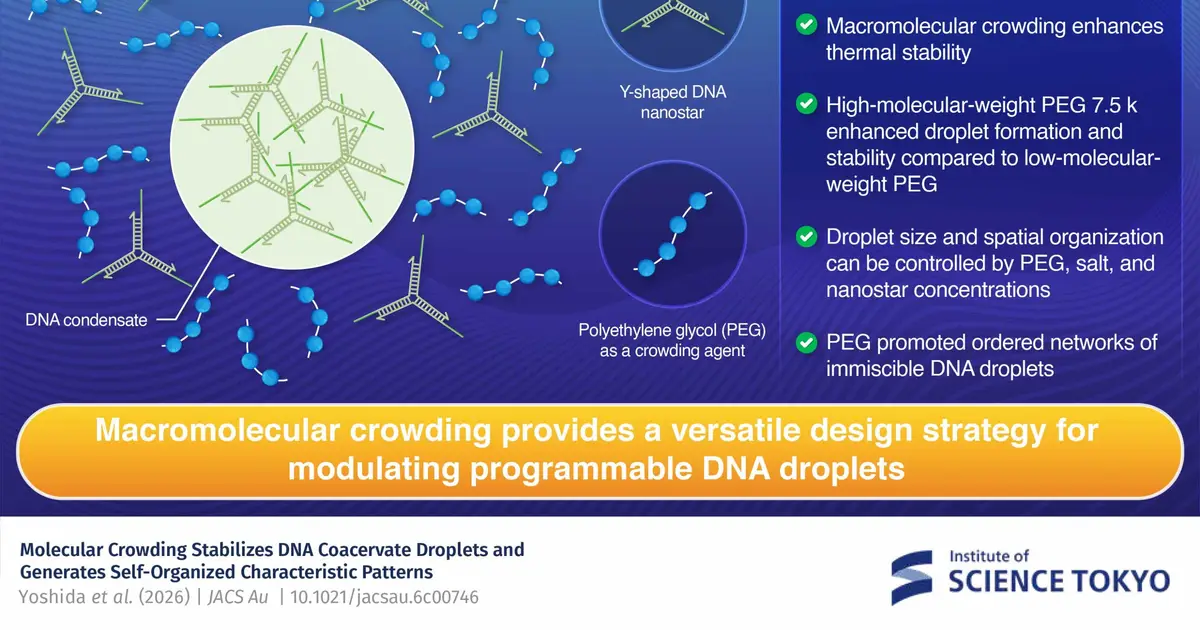
Macromolecular crowding can serve as a design tool for controlling the formation and organization of synthetic DNA droplets, a study from Science Tokyo reveals.

Summary
Macromolecular crowding can serve as a design tool for controlling the formation and organization of synthetic DNA droplets, a study from Science Tokyo reveals. Researchers investigated this strategy using DNA nanostars and polymeric crowding agents to mimic the crowded cellular environment. They found that crowding promoted droplet formation and enabled control over droplet size, interactions and organization. The findings could support the development of programmable artificial cell systems.
AI summaries can be wrong sometimes—always verify important details using the source article.
How AI & Automation are usedMore from Science
Continue reading recent Science coverage
- These 1970s Kids Had to Stay in School For 1 Year Longer. Decades Later, The Results Are Dramatic.Continue reading
- The phantom lighthouse: New research explains one of Australia's strangest illusionsContinue reading
- Ultrathin metal layer boosts spin-related signals, opening a door to ultralow-power electronicsContinue reading
- ULA's Vulcan rocket is set to return to flight on Friday the 13thContinue reading
Support HappeningNow
Independent AI-powered news analysis is reader-supported. Your contribution helps cover infrastructure, summaries, and continued platform development.
Support HappeningNow