
Science · 4 views
Ultracold atoms reveal first direct view of bound-pair motion in a fracton system
Particles can generally move between neighboring sites in a crystal, a solid in which atoms are arranged in a regular, repeating pattern, or an optical lattice, an arrangement of laser-based traps that confines atoms.

AI Summary
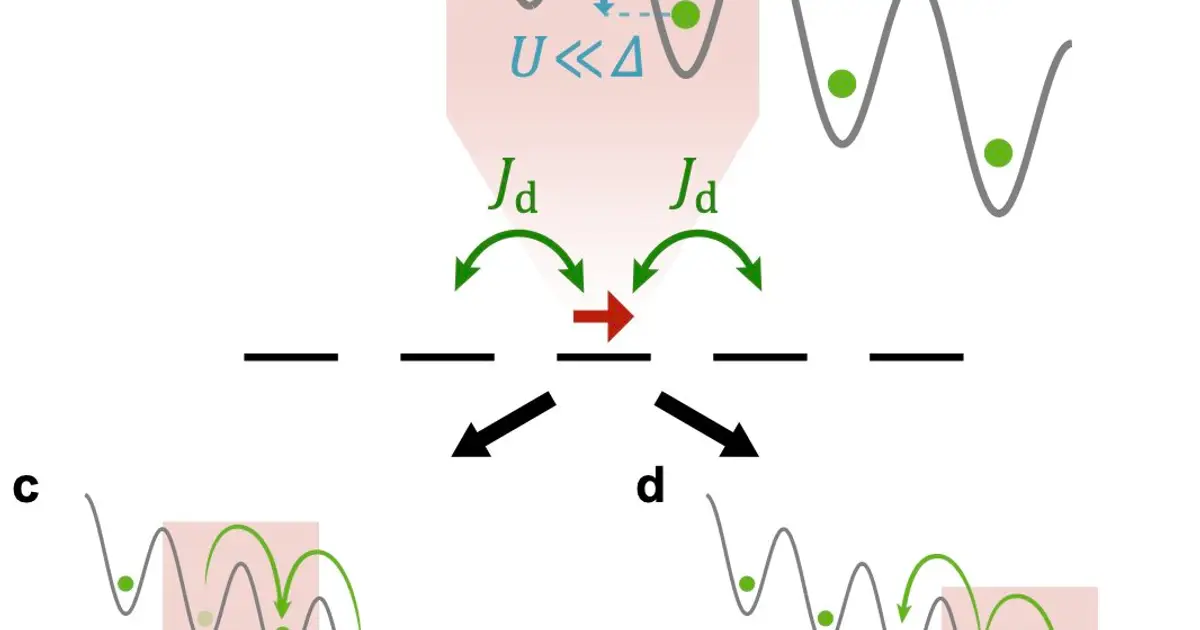
In a crystal or optical lattice, atoms normally hop between neighboring sites. A steep potential gradient makes such hopping energetically difficult. Under these conditions, particle interactions can still enable coordinated motion that keeps the system’s center of mass fixed. This coordinated motion produces fractonic behavior, where individual excitations called fractons cannot move alone, but bound states of these excitations can travel. The study demonstrates how interactions allow bound pairs to move while single fractons remain immobile.
AI summaries can be wrong sometimes—always verify important details using the source article.
How AI & Automation are usedMore from Science
Continue reading recent Science coverage
- Perfect employees and managers may not be the perfect matchContinue reading
- 18 brilliant and surprising gifts for science lovers this ChristmasContinue reading
- 2,200-year-old Roman shipwreck reveals an ingenious waterproofing trickContinue reading
- Toddlers form complex memories but may then lose access to themContinue reading
Support HappeningNow
Independent AI-powered news analysis is reader-supported. Your contribution helps cover infrastructure, summaries, and continued platform development.
Support HappeningNow