
Science · 4 views
Light-pulse pairs reveal the femtosecond decay of an inner-shell hole in xenon atoms
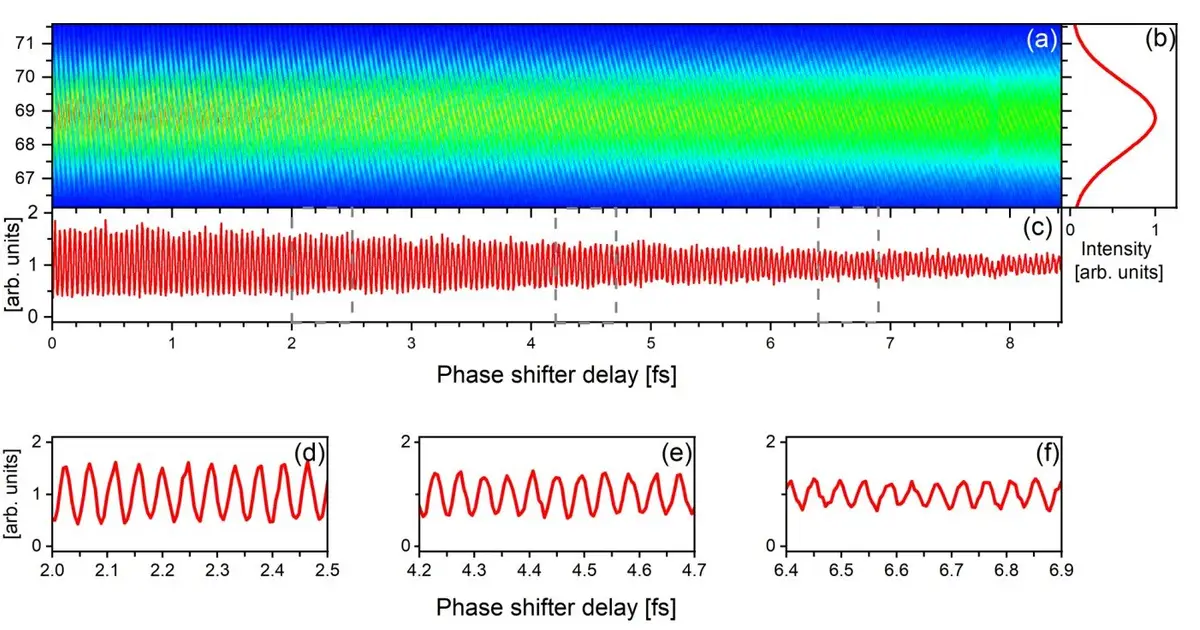
Researchers at the UVSOR Synchrotron Facility (Institute for Molecular Science, Japan) and partner institutions have observed the decay of a xenon 4d core hole, an inner-shell vacancy, directly in the time domain.

AI Summary
Researchers at Japan’s UVSOR Synchrotron Facility and collaborators directly observed the femtosecond decay of a xenon 4d core hole using pairs of phase‑coherent extreme ultraviolet pulses. By creating interfering photoelectron wave packets, they measured a rapid drop in fringe contrast as the pulse delay increased, indicating a decay time of roughly six femtoseconds. A model based on literature core‑hole lifetimes reproduced this behavior, confirming that Auger decay—where a valence electron fills the vacancy and another electron is emitted—dominates the process. The work offers a coherent‑pulse‑pair alternative to attosecond streaking for time‑domain studies of inner‑shell dynamics.
AI summaries can be wrong sometimes—always verify important details using the source article.
How AI & Automation are usedMore from Science
Continue reading recent Science coverage
- Scientists Simulated What Earth Would Be Like if Life Never ExistedContinue reading
- Global carbon emissions set to fall in 2026 due to Iran energy shockContinue reading
- Gatineau Park foliage reveals local Cold War nuclear testing legacyContinue reading
- Anglo-Saxon kingdom chose copper coins despite abundant silverContinue reading
Support HappeningNow
Independent AI-powered news analysis is reader-supported. Your contribution helps cover infrastructure, summaries, and continued platform development.
Support HappeningNow