
Science · 165 views
Breaking through AlphaFold's limits to predict how proteins change shape
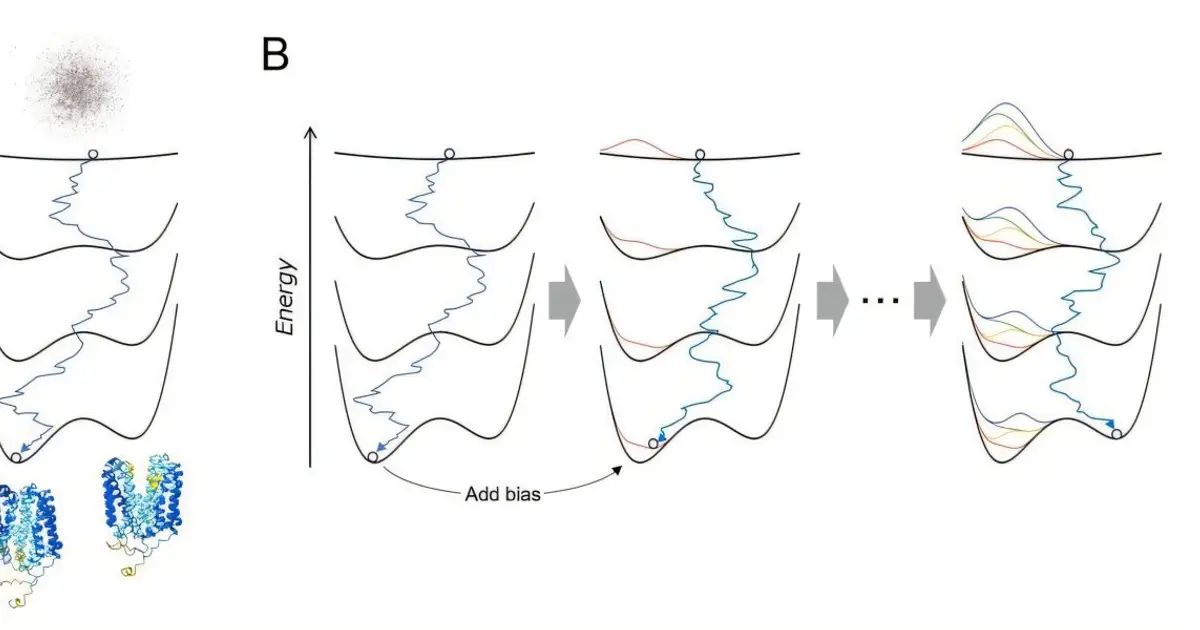
Conformational changes in proteins are vital to their function yet remain challenging for state-of-the-art artificial intelligence, such as AlphaFold3, to predict.

AI Summary
Researchers at the Institute for Molecular Science and the Graduate University for Advanced Studies introduced a repulsive force between predicted protein structures to bias AlphaFold3’s diffusion generative model. This modification enhances the model’s ability to sample multiple conformational states that the default settings rarely capture. The approach addresses the challenge of predicting protein shape changes in response to cues such as ligand binding, which are essential for functions like synthesis and transport. The study demonstrates a new method for improving conformational sampling in state‑of‑the‑art protein‑folding AI.
AI summaries can be wrong sometimes—always verify important details using the source article.
How AI & Automation are usedCoverage Context
More from Science
Continue reading recent Science coverage
- Rubin observatory reveals two hidden companions of the Milky WayContinue reading
- Cosmic microwave background offers evidence of gas flowing in galaxy clustersContinue reading
- New tropical protea flowers expand floriculture opportunities across HawaiʻiContinue reading
- There's a Curious Link Between Your Childhood Imaginary Friend And an Uncanny Feeling Later in LifeContinue reading
Support HappeningNow
Independent AI-powered news analysis is reader-supported. Your contribution helps cover infrastructure, summaries, and continued platform development.
Support HappeningNow