
Science · 34 views
'Aquila Booster' challenges theoretical limits of particle acceleration in pulsar wind nebulae
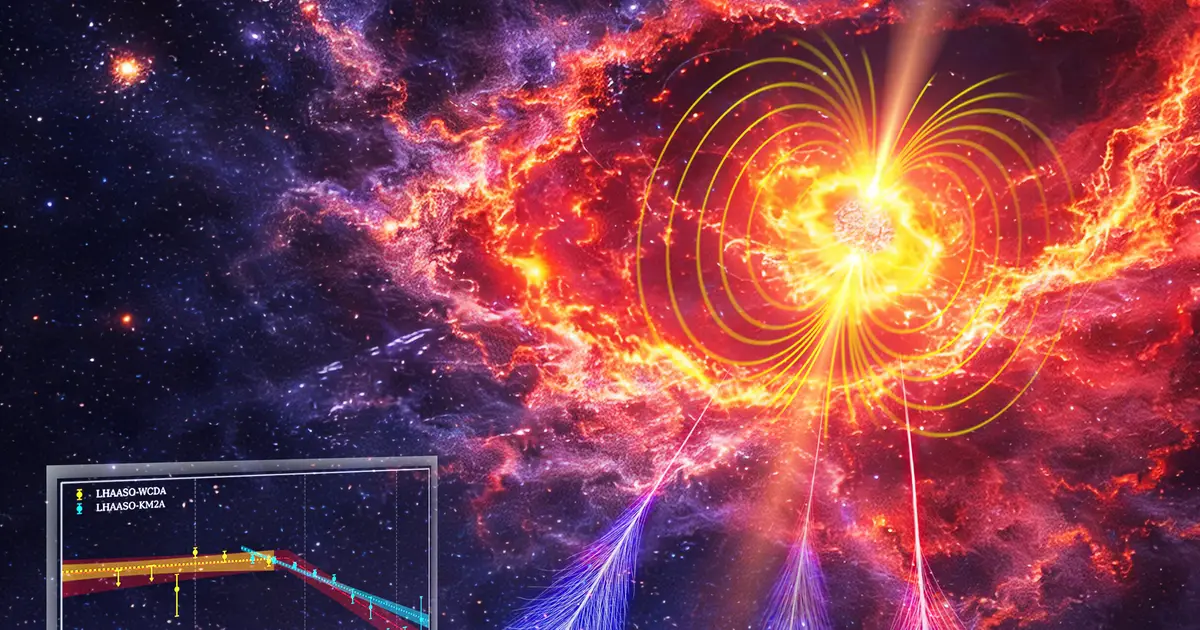
The Large High Altitude Air Shower Observatory (LHAASO) has detected PeV (1015 eV) gamma-ray emission from a pulsar wind nebula powered by PSR J1849-0001 in the constellation Aquila, marking the discovery of a new PeVatron and posing a…

Summary
The Large High Altitude Air Shower Observatory (LHAASO) has detected PeV (1015 eV) gamma-ray emission from a pulsar wind nebula powered by PSR J1849-0001 in the constellation Aquila, marking the discovery of a new PeVatron and posing a challenge to the classical theory of particle acceleration in pulsar wind nebulae.
AI summaries can be wrong sometimes—always verify important details using the source article.
How AI & Automation are usedMore from Science
Continue reading recent Science coverage
- Chemically modified sugars enable direct nanostructure formationContinue reading
- Elections are more predictable than they lookContinue reading
- Inside the Pentagon, the pressure is on to find a home for a new spaceportContinue reading
- Tiny Genetic Tweak From An Ancient Virus Might've Prevented Chimpanzees From Developing Brains Like OursContinue reading
Support HappeningNow
Independent AI-powered news analysis is reader-supported. Your contribution helps cover infrastructure, summaries, and continued platform development.
Support HappeningNow