
Science · 2 views
Adjustable nanosensors turn water pressure into fluorescent signals, with stiffness shaping sensitivity
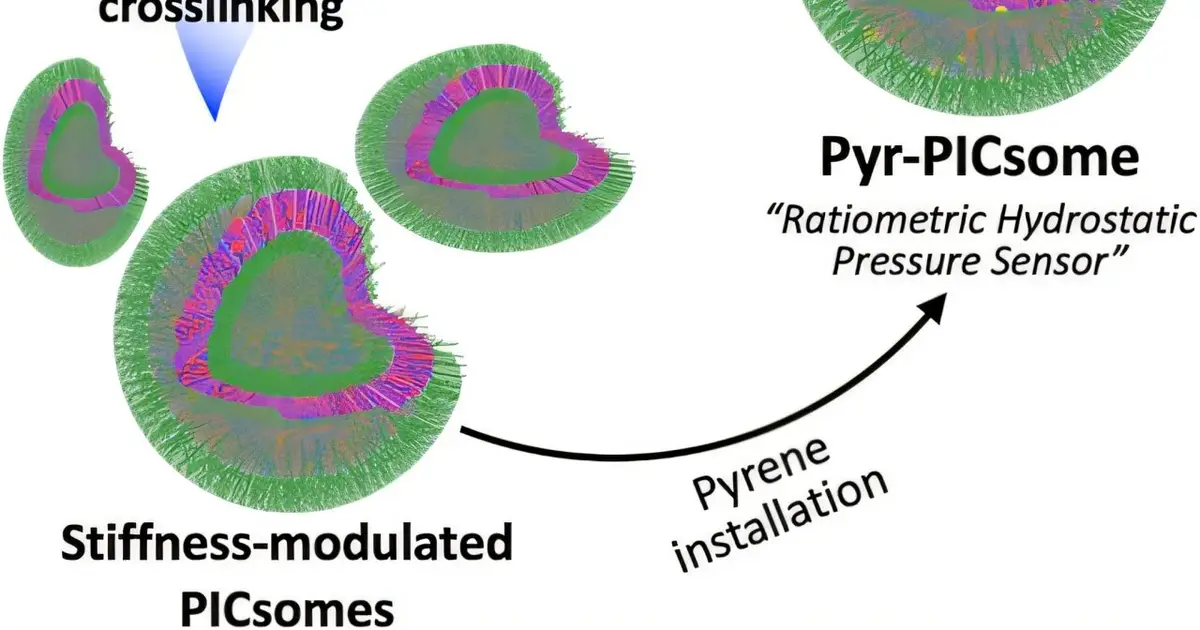
A novel nanovesicle-based platform developed at Institute of Science Tokyo can measure hydrostatic pressure by converting pressure-induced molecular changes into fluorescence signals.

AI Summary
A new nanovesicle platform created at the Institute of Science Tokyo detects hydrostatic pressure by turning pressure‑induced molecular changes into fluorescent signals. The team engineered pyrene‑modified polyionic complex vesicles whose membrane stiffness determines pressure sensitivity. Softer vesicles respond strongly across a 0.1–50 MPa range, while stiffer vesicles exhibit pressure‑dependent shifts in fluorescence lifetime. This tunable approach links mechanical stiffness to optical readouts, enabling adjustable pressure sensing at the nanoscale.
AI summaries can be wrong sometimes—always verify important details using the source article.
How AI & Automation are usedMore from Science
Continue reading recent Science coverage
- Aspens 'remember' past drought in their leaves, 3-year experiment findsContinue reading
- Polar oceans store carbon—but policy is not yet ready to count itContinue reading
- Nightjar wings reveal a trade-off between hunting slowly and traveling farContinue reading
- 'Mix-and-match' material's properties can be tuned by changing its metallic 'recipe'Continue reading
Support HappeningNow
Independent AI-powered news analysis is reader-supported. Your contribution helps cover infrastructure, summaries, and continued platform development.
Support HappeningNow